Strength trainingfor women over 50
Building muscle after fifty works. Just not the way it did at thirty. What changes in muscle, bone and joints after menopause, and what training can change about it.
Every number on this page is sourced and can be checked.


Then why has my training stopped working?
Your programme didn't get worse. The stimulus has to get stronger for your body to keep adapting to it at all.
From your last period onwards, oestrogen is missing in four places at once. Muscle responds more slowly to protein. Tendon takes longer to build. And bone only reacts to loads that wouldn't have been necessary before.
Can I still build muscle after fifty?
Yes. The muscle just doesn't respond to the same protein the way it did at thirty.
The term for it is anabolic resistance. How much smaller the building response gets after menopause cannot be put in a number honestly — nobody has measured one that holds up for this group. So there is no number here. What is established is the direction: the stimulus has to be bigger for the same thing to come out the other end.
And there is something that gets mistaken for ageing. Menopause drives the loss of muscle mass in its own right, independently of how old you are and how much you move. It isn't only the years passing.
The muscle also doesn't just get smaller. It mainly gets weaker. Since 2019 the European definition of sarcopenia puts strength first and mass second. Which means the thing worth watching isn't the circumference of your upper arm. It's whether the case of water still gets up onto the counter.
So can't I just eat more protein?
No, and that is the uncomfortable answer. Women after menopause who did resistance training built no more lean mass on far more protein than recommended than they did on the ordinary amount. And two years of whey protein improved neither muscle mass nor physical function in well-nourished women after menopause.
Protein is the material. The stimulus is the work order. Without the order the material just sits there.
Does bone still react at all once the hormones are gone?
Yes. And exactly where you load it.
That can be shown cleanly when each woman competes against herself. Thirty-five women between 55 and 70 spent six months doing single-leg hops in different directions, but on one leg only. The other leg did nothing.
Bone density at the femoral neck, trained leg
Bone density at the femoral neck, other leg
Same hormone levels, same food, same age, same sleep. Both legs belonged to the same woman, so each was her own control. The difference can only come from the loading.
So bone doesn't spread the stimulus around the body. It adapts exactly where it is loaded. And it does that without hormones.
Why doesn't my class do anything, then?
Because nearly every programme sold to our age group advertises itself with the same four words: gentle, joint-friendly, no floor work, no jumping.
That is very close to the description of a home programme that has been studied. Eighty-five per cent of the planned sessions actually got done, a rate most classes only dream of. After eight months bone density had gone down anyway.
of sessions completed
Bone density, lumbar spine
Bone density, femoral neck
These women were genuinely disciplined. The stimulus was still too weak.
So what has to be different?
There are exactly two dials, and most programmes turn neither of them. Whether you call it strength training, resistance training or weight training makes no difference to either one.
How hard
Bone only reacts once it measurably deforms. Without that stronger stimulus it makes no adaptation at all. And it gets used to things: a weight that was heavy six months ago is medium today, and therefore a weaker stimulus. Pick up the same dumbbells for years and you are training with a signal that gets quieter every year.
How fast
The same load, applied faster, is a different stimulus. That is what sits behind the word impact, which appears in every recommendation and is almost never explained. Impact is not a heavy load. Impact is a load that arrives quickly: a landing, a hop, a step down off a stair.
This has a name
Progressive overload. It means nothing more than that the stimulus grows with you as you get stronger.
Because the term gets sold as a promise, the limit belongs with it: the German fracture-prevention guideline could not demonstrate that programmes with load progression beat programmes that stay the same. For bone density, the progression is not proven.
The reason to do it anyway is in the first dial: a stimulus you have got used to isn't one any more.
Then there is frequency, and that part is pleasantly simple: twice a week, averaged over the year. At one session a week there was no effect at the lumbar spine. More than two is not expected to add anything.
And one thing has nothing to do with bone at all. The dangerous fracture usually comes from the fall. So balance, changes of direction and the way up off the floor are in every session. That is exactly how the builder is sorted.
Two things worth their own page
So what do I do now?
Four things are here, and all of them are free.
The exercise builder
Tell me where you are and what you've got. No sign-up.

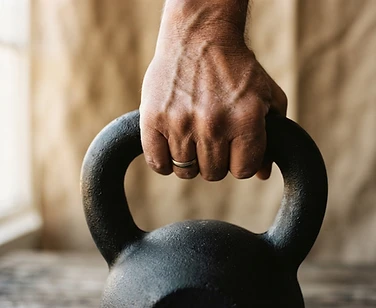
The movements on video
Every movement from the book. Seeing it once explains more than three paragraphs.
The first four weeks
Find your anchor, get to know the tasks, the first session, watch. One step per week.

The symptom diary
Runs only on your device. Print it and take it with you.

What's in the book?
Ten chapters on what happens to muscle, bone and joints after fifty, and on what training can change about it. Every number in it is sourced, with DOI and PMID in the appendix.
The book explains why. This site tells you what to do with it today.
It ends with four weeks to get started: find your anchor, get to know the tasks, the first structured session, watch what changed.
[PUBLICATION NOTE]

Who's writing this
Vanessa Schumacher. On the mat since 1990, coaching since 1994.
In my own gym the fitness classes were full of women over forty. On the mat, in the same building, there wasn't one. And not one of them ever said she didn't want to.
Martial arts is my way in. Not the only one and not the best one. What matters is that you start something.
Every number on this site is in the book, and every one of them can be checked. The full reference list is a free download, with DOI and PMID.